Choosing a Sky Drone Show supplier is less about spectacular footage and more about controlled delivery, measurable safety, and dependable communication. A professional supplier should provide evidence, not promises. Ask who owns the aircraft, operates the flight software, and carries responsibility onsite. Examine fleet age, battery records, pilot qualifications, insurance, maintenance logs, and emergency procedures. That paperwork can feel unexciting. It often separates a safe performance from a fragile one.
Industry data provides useful context, though definitions vary. Fortune Business Insights valued the global drone market at approximately USD 30.6 billion in 2023, showing strong commercial momentum beyond entertainment. Drone Industry Insights’ Drone Market Report 2024 also maps expanding professional drone applications, but it does not isolate drone-show revenue. That limitation matters. A large market forecast cannot prove a supplier can execute a 400-aircraft formation over your venue. Use reports as context, not as a substitute for verification.
Compare suppliers through flight demonstrations, client references, technical drawings, and site-specific risk assessments. Request a rehearsal plan covering launch zones, crowd distances, weather thresholds, backup aircraft, and communication channels. FAA and EASA materials emphasize operator competence, airspace compliance, and structured risk management. Confirm local permissions early, because requirements differ across jurisdictions and venues. Ask how the team handles wind, signal loss, delayed starts, and incomplete formations. The best proposal explains trade-offs clearly. I would still challenge every impressive claim. Experience is valuable, but documented process is more reliable.
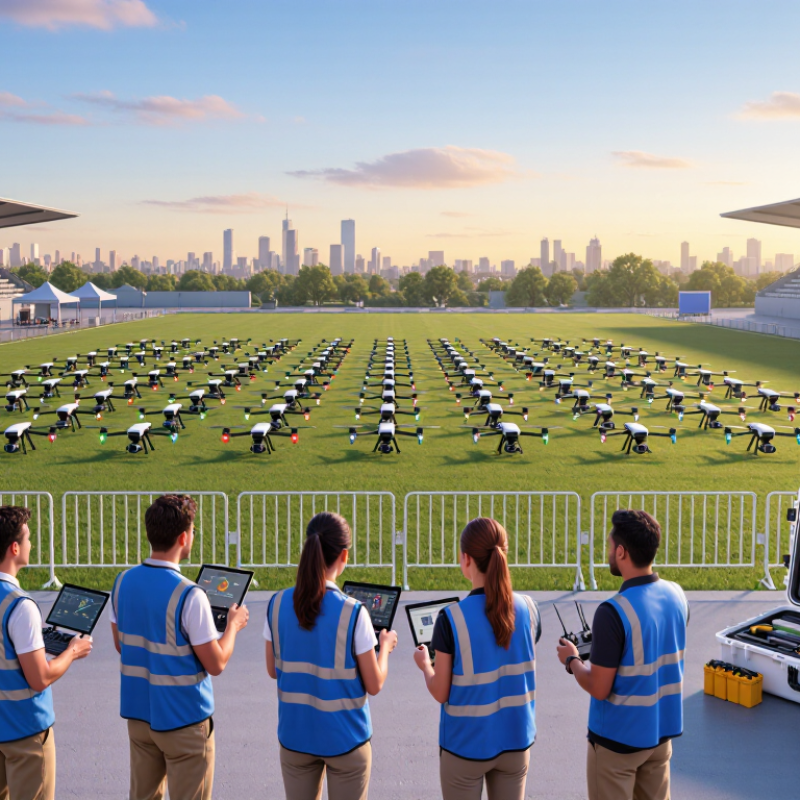
Choosing a sky drone show supplier starts with defining your event requirements. Decide what the audience should feel: wonder, celebration, or a clear brand story. Set measurable goals, such as a 10-minute finale, three animated scenes, or 500,000 social impressions. A vague brief often creates expensive revisions.
Review the venue in practical detail. Record its coordinates, nearby buildings, crowd capacity, launch area, viewing angles, and emergency access. Confirm the required flight duration, music synchronization, animation complexity, maximum drone count, and weather limits. Grand View Research valued the global drone market at approximately USD 73.06 billion in 2022, showing rapid technical growth, but market size does not guarantee show quality. Ask suppliers for flight-test evidence, safety procedures, insurance, pilot qualifications, and documented approval processes from the relevant aviation authority. Rules differ by location.
Tips: Create a one-page event brief. Include date, audience size, venue map, budget range, storyline, music rights, and fallback plans. Ask for a realistic wind threshold and cancellation policy. Do not accept “any design is possible” without technical limits. A useful supplier should challenge weak assumptions, including mine. For example, a beautiful animation may be unreadable from the actual audience distance. The Event Safety Alliance recommends planning through hazard identification, communication, and contingency controls; apply those principles before comparing prices. Leave time for rehearsals, because software previews rarely reveal every real-world issue.
Choosing a sky drone show supplier starts with safety evidence, not dazzling videos. Ask for current operator certificates, airspace approvals, insurance, and documented risk assessments. In the United States, the FAA requires Remote ID for most registered drones and controlled-airspace authorization. European suppliers should explain their EASA operating category and local authority approvals. A license alone is not enough.
Technical depth matters during a real performance. Request maintenance logs, battery-cycle records, firmware controls, and pilot-to-drone ratios. The fleet should use reliable positioning, communication redundancy, geofencing, and automatic emergency landing procedures. Ask how the team reacts to wind, rain, lost signals, or a drone drifting beyond its planned formation. Watch the rehearsal closely. A polished demo is not proof.
Drone Industry Insights’ 2024 market analysis estimates the commercial drone market could grow from about 30.6 billion dollars in 2023 to over 54 billion dollars by 2030. Rapid growth can attract inexperienced suppliers. That is a concern. Require evidence from comparable events, independent safety audits, and incident records, not only testimonials. Verify who makes the final go-or-no-go decision. Weather calls remain uncomfortable, even for experienced teams. A supplier that admits operational limits may be more reliable than one promising perfection.
Choosing a sky drone show supplier starts with fleet reality, not glossy animation. Ask how many aircraft are flight-ready, reserved, and maintained. A large fleet means little when batteries, radios, and trained crews are weak.
Grand View Research estimated the global drone services market at USD 17.1 billion in 2023, with strong projected growth. That growth attracts inexperienced operators. Inspect evidence, not promises.
Software should manage formations, collision spacing, geofencing, weather checks, and emergency landing procedures. Request a live simulation and a written recovery plan.
Creativity means more than colorful logos. Ask for original storyboards, music synchronization, readable shapes, and viewing-distance tests.
Customization should include aircraft numbers, launch sites, altitude, duration, colors, languages, and narrative choices.
The FAA Aerospace Forecast 2024–2044 also points to expanding commercial drone activity. Bigger is not automatically better.
I have seen impressive previews hide poor sightline planning. That mistake is expensive.
Tips: Compare three proposals with identical requirements.
Request flight logs, insurance evidence, maintenance records, and software demonstrations.
Test one small rehearsal. Check whether animation changes require rebuilding the entire mission.
A practical scorecard beats excitement. Leave contingency time.
Price should be judged by deliverables, not by the headline figure. Grand View Research’s 2024 commercial drone report forecasts a 13.9% compound annual growth rate through 2030. Rising demand can increase crew, software, insurance, and maintenance costs. Request an itemized quotation covering aircraft numbers, creative design, rehearsals, transport, permits, safety staff, and backup equipment. Ask whether taxes, weather delays, and venue changes are included. Cheap quotes often omit the difficult parts.
Services reveal operational maturity. Require a site survey, flight-risk assessment, audience-distance plan, and written emergency procedure. The supplier should explain battery handling, radio coordination, launch zones, and recovery processes in plain language. The European Union Aviation Safety Agency’s 2024 annual safety review reinforces the value of documented risk management and competent operators. Do not accept vague assurances. Ask for evidence.
Timelines deserve equal attention. A complex show may need several weeks for storyboarding, approvals, music synchronization, testing, and local coordination. Request a milestone schedule with named responsibilities. Past performance matters more than polished videos. Examine dated case studies, client references, weather-contingency records, and completion rates. A supplier that has delivered many small shows may not suit a stadium audience. I would also ask for an honest failure review. That answer can be more useful than perfect testimonials. Even experienced teams can underestimate wind, venue access, or approval time. Include those risks in the contract.
How to Choose a Sky Drone Show Supplier?
A supplier’s contract should describe more than flight dates and creative concepts. It should name the responsible operator, aircraft limits, insurance coverage, permits, weather thresholds, and cancellation terms. The FAA’s 2024 Aerospace Forecast expects commercial small-UAS operations to exceed one million aircraft during its forecast period. That growth makes documented safety procedures essential, not decorative paperwork.
Ask for a written backup plan. It should cover rain, high winds, radio interference, GPS problems, battery faults, and missing aircraft. A credible supplier should explain replacement-unit ratios and emergency landing zones. Keep it specific. “We will manage risks” is not enough. The contract should state refund rules, rescheduling windows, and who pays for extra venue costs. The Event Safety Alliance’s guidance repeatedly emphasizes defined roles, communication systems, and contingency planning for live events.
On-site support matters just as much. Require a trained show director, safety officer, technician, and clear contact channel during setup and performance. Request a rehearsal schedule, launch-area inspection, crowd-distance controls, and a post-show incident report. Drone Industry Insights’ 2024 market analysis identifies regulation and operational complexity as continuing industry barriers. That matches field experience: elegant animations can fail when a venue changes its access time. I would also ask for references from comparable venues. One weakness remains common: suppliers sometimes promise perfect reliability. Weather is not negotiable. A realistic plan admits uncertainty and shows how the team will respond.
| Evaluation Area | Weight | What to Confirm | Practical Benchmark | Required Contract Evidence | Warning Sign |
|---|---|---|---|---|---|
| Contract Scope | 15% | Check whether the agreement covers show design, aircraft, pilots, permits, insurance, transport, setup, operation, and post-show reporting. | All major deliverables, dates, responsibilities, and acceptance criteria are listed in one signed agreement. | Detailed statement of work, payment milestones, cancellation terms, change-order process, and liability allocation. | Important services are described only in emails or verbal discussions. |
| Regulatory Compliance | 15% | Verify that the supplier understands local aviation rules, operating zones, pilot qualifications, site restrictions, and authority approvals. | A written permit schedule identifies the responsible party, submission dates, approval status, and contingency dates. | Permit responsibilities, compliance documents, pilot credentials, risk assessment, and authority-approval conditions. | The supplier promises approval without identifying the regulator, timeline, or required documents. |
| Fleet Capacity | 10% | Confirm the number of available aircraft, spare units, battery capacity, charging equipment, and maintenance procedures. | The planned fleet supports the show design with an agreed reserve of aircraft and critical equipment. | Equipment schedule, reserve percentage, maintenance checklist, battery plan, and replacement procedures. | The quoted fleet exactly matches the animation requirement with no reserve equipment. |
| Weather Backup Plan | 15% | Ask how wind, rain, lightning, visibility, temperature, and local safety restrictions affect the performance. | The contract defines weather thresholds, go/no-go decision times, postponement options, and refund or rescheduling rules. | Written weather policy, decision authority, postponement window, communication procedure, and cost treatment. | The supplier uses vague language such as “weather permitting” without measurable thresholds. |
| Technical Backup | 10% | Confirm backup systems for communication, control software, batteries, navigation equipment, lighting, and media files. | Critical systems have tested replacements, offline copies, and a documented failure-response procedure. | Technical contingency plan, system test records, data backup method, and emergency shutdown procedure. | There is no documented response if an aircraft, control link, or show file fails before launch. |
| On-Site Show Support | 15% | Confirm the number and responsibilities of on-site pilots, technicians, safety staff, project managers, and client contacts. | A named on-site team is present for setup, testing, rehearsal, launch, monitoring, shutdown, and site clearance. | Staffing plan, arrival schedule, communication hierarchy, rehearsal plan, and incident-escalation process. | The supplier cannot confirm who will be on site or who has authority to stop the show. |
| Site Logistics | 8% | Review launch-zone access, crowd separation, power supply, charging areas, security, transport, and teardown requirements. | A site plan shows launch and spectator zones, safety distances, access routes, equipment areas, and emergency exits. | Scaled site map, access schedule, power requirements, loading plan, safety perimeter, and site-owner approvals. | The supplier has not requested a site survey or cannot explain its power and access requirements. |
| Insurance & Liability | 7% | Check public liability coverage, aviation-related exclusions, employer coverage, property damage, and subcontractor responsibility. | Coverage is valid for the event location and date, with limits accepted by the venue and relevant authorities. | Certificate of insurance, policy limits, exclusions, indemnity clauses, and subcontractor insurance obligations. | Insurance proof is unavailable, expired, location-restricted, or excludes drone operations. |
| Show Quality & Testing | 3% | Confirm animation review stages, rendering specifications, color limitations, music synchronization, and rehearsal requirements. | The client receives a design proof and has at least one documented technical or visual approval stage. | Creative approval schedule, revision limits, file specifications, rehearsal conditions, and final sign-off method. | The final visual result is promised without a formal review, preview, or approval process. |
| Pricing Transparency | 2% | Separate creative fees, aircraft operation, permits, travel, accommodation, insurance, venue costs, taxes, and overtime. | The quotation identifies inclusions, exclusions, optional services, payment timing, and possible additional charges. | Itemized quotation, tax treatment, cancellation charges, travel assumptions, and written change-order rates. | The lowest price excludes permits, backup equipment, travel, or on-site technical support. |
| Recommended Selection Rule | Choose the supplier with the strongest documented risk controls, not simply the lowest quote. | ||||